The $40 Billion Question: Should You Become an Influencer in 2026?
Every day, your feed is flooded with them. Perfectly curated lives. Sponsored posts. “Link in bio.” The promise of a life where attending brand launches is a job, and a 30-second video can pay a month’s rent.
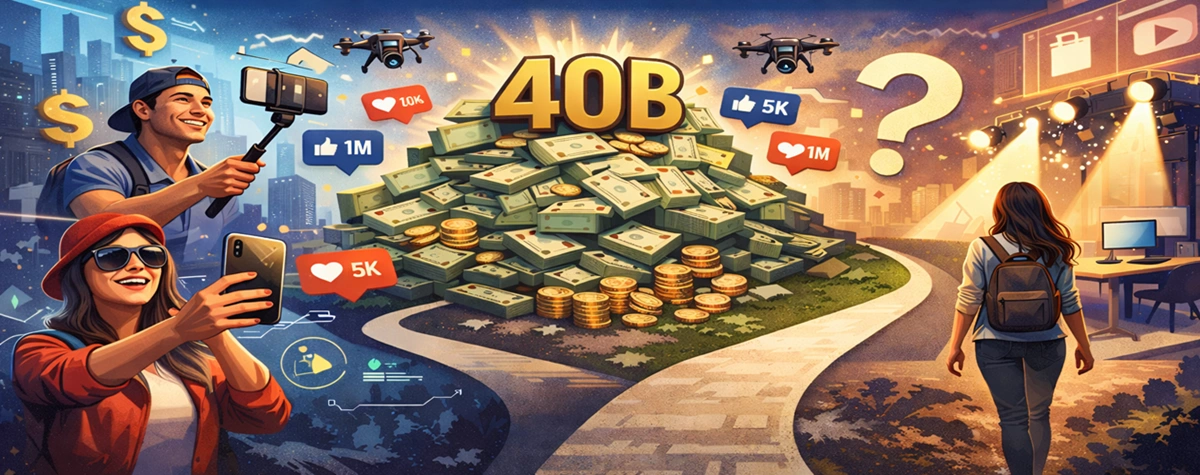
The creator economy is projected to hit $40 billion in the US alone in 2026, with global estimates exceeding $230 billion . It’s no longer a side hustle; it’s a legitimate economic force. Major companies like Meesho are launching dedicated creator platforms, and marketing giants like Publicis Groupe are acquiring influencer marketing firms for millions.
But the glossy surface hides a more complex reality. As the industry matures, the question “Should I become an influencer?” is no longer simple. The answer in 2026 isn’t a yes or no—it’s a “it depends.”
Here is the unvarnished truth about the creator economy in 2026: the opportunities, the hard realities, and the framework for deciding if this path is for you.
The Allure: Why Everyone Still Wants In
Let’s start with the numbers that make eyes widen. Creator revenue is projected to grow 16.2% in 2026, reaching $20.6 billion. Full-time creators are expecting an average revenue increase of 78% this year. These aren’t marginal gains; they’re explosive growth.
The opportunity isn’t just about money. It’s about autonomy. It’s about building a business that lives where culture happens. Top creators are no longer just faces for hire; they’re being invited into brand strategy rooms as consultants and creative partners . Eve Lee, founder of The Digital Fairy, describes this shift as moving from “influencer-as-reach to creator-as-counsel” .
Brands are voting with their wallets. 86% of brands have integrated influencer marketing into their paid media strategy, and 82% plan to increase their budgets in 2026 . CMOs are reallocating billions from traditional TV and print to creator-driven campaigns. The tectonic plates of marketing are shifting, and creators are sitting at the epicentre.
The Reality Check: Why Most Don’t Make It
But here’s the statistic they don’t put on the posters: 57% of marketers struggle to measure ROI from influencer campaigns. If brands can’t prove value, they eventually cut budgets. And when they cut, they cut the middle first.
The creator economy is no longer a meritocracy of viral luck. It is a professionalised industry where 68% of creators now have three or more years of experience. The amateurs are being squeezed out by seasoned operators who understand platform algorithms, audience psychology, and business fundamentals.
Consider these ground realities:
1. The Monetisation Mix Has Changed
Brand deals still dominate, with 82% of creators relying on them as a primary income source . But the smart money is diversifying. 54% of creators are now pursuing affiliate marketing, and 42% are exploring UGC (user-generated content) licensing . The creators who survive platform changes and brand budget shifts are those who build multiple revenue streams—like a traditional small business owner, not a one-trick pony.
2. The Middle Class of Influence Is Real
The days when only mega-influencers with millions of followers could earn a living are over. Nano-creators (1k–10k followers) are dominating engagement on platforms like TikTok. Mid-tier, specialised creators—who sit between micro and macro—are quietly driving the most meaningful influence in niches like personal finance, parenting, and sustainability.
Also Read: The Vulnerability Economy: Why Gen Z’s “Messy” Mindset Is the Biggest Business Opportunity of 2026
Why? Because follower counts have lost their authority. In the age of the algorithm, what matters is content quality and cultural relevance, not audience size alone. A creator with 5,000 engaged followers can now out-earn someone with 50,000 passive ones .
3. Authenticity Is the Only Currency
Consumers have become cynics. They can smell a scripted brand read from a mile away. Research from Imperial College London reveals that over a third of consumers think influencers misrepresent themselves, and almost half think most are fake .
The antidote? Radical authenticity. Audiences now value experience over formal credentials—trusting amateur runners more than Olympic athletes, for example. They want creators who admit flaws, engage in two-way conversation, and are honest about commercial relationships. Trying to hide a paid partnership? Research shows 96% of sponsored posts go undisclosed, and consumers are increasingly punishing this opacity.
4. AI Is Not the Enemy—Yet
There was widespread fear that AI influencers would replace humans. It hasn’t happened. 89% of marketers say they have no plans to partner with virtual influencers. Consumer enthusiasm for AI-generated creator content has plummeted from 60% to just 26%.
As Eve Lee puts it: “AI can’t read the room or scrape the messiness of human desire”. In a world drowning in automated content, human perspective is the premium product.
The Framework: How to Decide If This Path Is for You
So, with all this context, how do you decide? Here is a practical framework for 2026.
You SHOULD pursue the creator path if:
- You have a defensible point of view.
In a sea of sameness, personality is IP. Gigi Robinson, a leading creator and brand designer, emphasises: “Personality is going to be what sets you apart, what’s built your IP, what makes the difference between you and another creator”. If you have a unique lens on a niche—whether it’s chronic illness, B2B marketing, or hyperlocal food—you have a foundation. - You’re building a business, not chasing fame.
The creators who last treat their channels as assets, not resumes. They’re thinking about IP ownership, audience diversification across platforms (including newsletters and podcasts), and long-term revenue models-5. If you’re willing to learn about conversion metrics, affiliate funnels, and contract negotiation, you’re suited for this game. - You can embrace the “consultant” mindset.
Brands are increasingly looking for creators who can contribute to strategy, not just execute posts. Forty percent of brands now give creators full creative control. If you have strategic thinking and can articulate what your audience truly wants, you’ll be hired not just for your reach, but for your brain. - You’re resilient to platform volatility.
TikTok could change its algorithm tomorrow. Instagram could deprioritise Reels. The creators who survive are those who build audiences they own—email lists, podcasts, Substack newsletters. If you’re willing to diversify your presence, you can weather any platform storm.
You should THINK AGAIN if:
- You’re only in it for the free products.
The era of trading product for posts is ending for serious creators. Brands now demand measurable ROI. If you’re not prepared to deliver performance, you’ll remain an amateur in a professionalising industry. - You’re uncomfortable with transparency.
Consumers now demand honesty about self-interest. If you’re not willing to clearly disclose sponsorships, admit when you haven’t used a product, or show your flaws, your audience will tune out. Trust is the only non-negotiable asset. - You’re looking for a “get rich quick” path.
The creator economy is now dominated by veterans with years of experience . The average successful creator has put in the time learning their craft, understanding their audience, and building relationships. This is a long game, not a lottery ticket. - You can’t handle measurement and metrics.
If the thought of analysing engagement rates, conversion data, and audience insights makes your eyes glaze over, you’ll struggle. Brands want partners who understand performance. The days of posting and praying are over.
The Verdict: A Middle-Class Creator Economy Is Emerging
Here’s the optimistic truth: the creator economy in 2026 is no longer a winner-take-all game. The middle class of influence is real and growing.
You don’t need millions of followers to earn a sustainable living. You need:
- A clear niche with an engaged community
- Diversified income(brand deals + affiliate + UGC + possible products)
- A professional approach to your craft and business operations
- Authenticity that builds trust over time
The market is projected to double to $40 billion. That growth will fund thousands of sustainable creator businesses, not just a handful of superstars.
Final Thought: The Window Is Open, But It Won’t Stay Open Forever
The creator economy is maturing rapidly. The infrastructure is being built—platforms for affiliate marketing, UGC licensing, and campaign measurement are becoming standard. The professionalisation means higher barriers to entry, but also higher rewards for those who clear them.
If you have a genuine perspective, a willingness to treat this as a business, and the resilience to navigate platform changes, 2026 is still a phenomenal time to start.
But come correct. Bring more than just a face. Bring a point of view, a strategy, and a commitment to the long haul. If you are building expertise in emerging fields like PGDM in Fintech, let that knowledge shape your perspective and the value you bring. The audience—and the brands—will thank you for it.