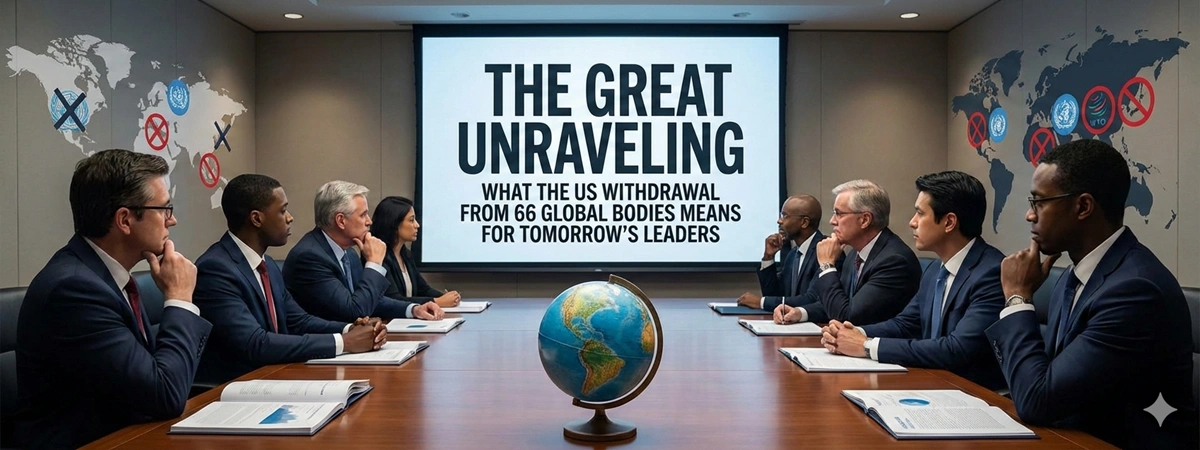
The Great Unraveling: What the US Withdrawal from 66 Global Bodies Means for Tomorrow’s Leaders
The global geopolitical landscape shifted dramatically with the news that the United States will withdraw from 66 international organizations. For students of International Relations and Business Management, this isn’t just a headline—it’s a real-time masterclass in power, strategy, and the future of global cooperation. As future diplomats and CEOs, understanding the architecture of this decision is crucial for navigating the world you will soon lead.
Deconstructing the Decision: A New “America First” Doctrine in Action
The move, formalized by a Presidential Memorandum, is framed by the administration as a restoration of American sovereignty and a rejection of what it terms “globalist agendas”. Secretary of State Marco Rubio characterized the targeted institutions as “redundant… mismanaged, unnecessary, wasteful… or a threat to our nation’s sovereignty”. This represents the crystallization of an “à la carte” approach to multilateralism, where cooperation is sought strictly on Washington’s own terms.
The breadth of the withdrawal is staggering, spanning 35 non-UN and 31 United Nations entities. The list targets entire pillars of the post-World War II international system:
- The Climate and Environmental Framework: The U.S. will exit the foundational UN Framework Convention on Climate Change (UNFCCC), the Intergovernmental Panel on Climate Change (IPCC), and the International Union for Conservation of Nature (IUCN). This makes the U.S. the first and only major economy outside the UN’s primary climate treaty.
- Development and Humanitarian Bodies: Withdrawals include the UN Population Fund (UNFPA), the UN Entity for Gender Equality (UN Women), and offices protecting children and civilians in armed conflict.
- Forums for Democracy and Rule of Law: Exits encompass the International Institute for Democracy and Electoral Assistance and the Venice Commission of the Council of Europe.
This follows a pattern of retreat from bodies like the World Health Organization and the UN Human Rights Council, signaling a profound redefinition of U.S. engagement with the world.
The Geopolitical Chessboard: Power Vacuums and Strategic Realignments
For the International Relations student, this is a pivotal case study in power transition theory and institutional resilience.
- The Leadership Vacuum: The U.S. abdication from climate, development, and democratic governance forums creates an immediate power vacuum. As one analyst noted, this “gives other nations the excuse to delay their own actions”. The question is: who will fill the void? The European Union, China, and coalitions of middle powers are likely to seize the initiative, reshaping global norms and standards without American input.
- The “My Way or the Highway” Model: This move exemplifies a transaction-al, zero-sum view of international politics. It challenges the very premise of collective action on transnational issues like climate change and public health. Your future diplomatic challenges will involve navigating a world where the traditional hegemon is selectively absent, making coalition-building more complex and adversarial.
- Institutional Adaptation: Global institutions face an existential test. The loss of U.S. funding and political participation will force severe cuts and restructuring. Will these bodies weaken, or will they adapt and find new sources of legitimacy and support? Their response will be a key area of study.
The Business Calculus: Risk, Opportunity, and the New Rules of the Game
For the Business Management student, this political decision translates into tangible strategic risk and opportunity.
- Supply Chain and Regulatory Fragmentation: Exits from bodies like the International Tropical Timber Organization or UN Conference on Trade and Development can lead to fragmented environmental and trade standards. Companies operating globally may face a patchwork of competing regulations instead of harmonized rules, increasing compliance costs and complexity.
- The Clean Energy Race: Withdrawing from the International Renewable Energy Agency and the International Solar Alliance isolates U.S. businesses from key forums setting the standards for the multi-trillion-dollar clean energy transition. As the World Resources Institute warned, “American communities and businesses will lose economic ground as other countries capture the jobs, wealth, and trade”. Future business leaders must strategize on how to compete when their home country has left the rule-making table.
- Elevated Political Risk: Retreat from peace building and counter-terrorism forums may correlate with increased instability in certain regions. This directly impacts corporate investments, market access, and operational security abroad. Risk assessment models must now weight “geopolitical withdrawal” as a new variable.
A Snapshot of Key Withdrawals & Their Implications
Organization Type | Notable Examples | Primary Impact Area | Implication for Future Leaders |
Climate & Environment | UNFCCC, IPCC, IUCN | Global Climate Governance | IR: Norm-setting without US. Biz: Missed green tech standards. |
Development & Social | UN Women, UN Population Fund | Gender Equality, Global Health | IR: Erosion of social agendas. Biz: Shifts in development funding. |
Trade & Commodities | Int’l Tropical Timber Org., UN Trade & Development | Global Trade Standards | IR: Competing trade blocs. Biz: Supply chain complexity. |
Democratic Governance | Int’l Institute for Democracy, Venice Commission | Democracy & Rule of Law | IR: Weakened democratic networks. Biz: Elevated political risk. |
Shaping Your Path in a Fragmenting World
So, what does this mean for you, as students poised to enter this new reality?
- For the IR Students: Your field just got more critical. Expertise in non-traditional diplomacy, coalition-building among middle powers, and crisis management within weakened institutions will be at a premium. Consider focusing on regions or countries poised to expand their influence.
- For the Business Students: Geopolitical risk analysis is no longer a niche skill—it’s core to strategy. Understanding how regulatory divergence affects supply chains, market entry, and competitive advantage is essential. Sustainability leadership will require navigating without a coherent national policy.
The administration’s claim is that this redirection saves taxpayer money and refocuses on “America First” priorities. The counter-argument, from critics and affected organizations, is that it constitutes a “strategic blunder” that cedes economic and diplomatic ground.
Ultimately, your generation will be tasked with managing the consequences: rebuilding bridges, innovating new forms of cooperation, and competing in a world where the rules are being rewritten, often in America’s absence.
Where do you see the greatest opportunity for leadership—in business or diplomacy—in this new global landscape?
Dr. M Samir Gopalan, Faculty Member, Silver Oak Institute of Business Management, Silver Oak College of Liberal Studies