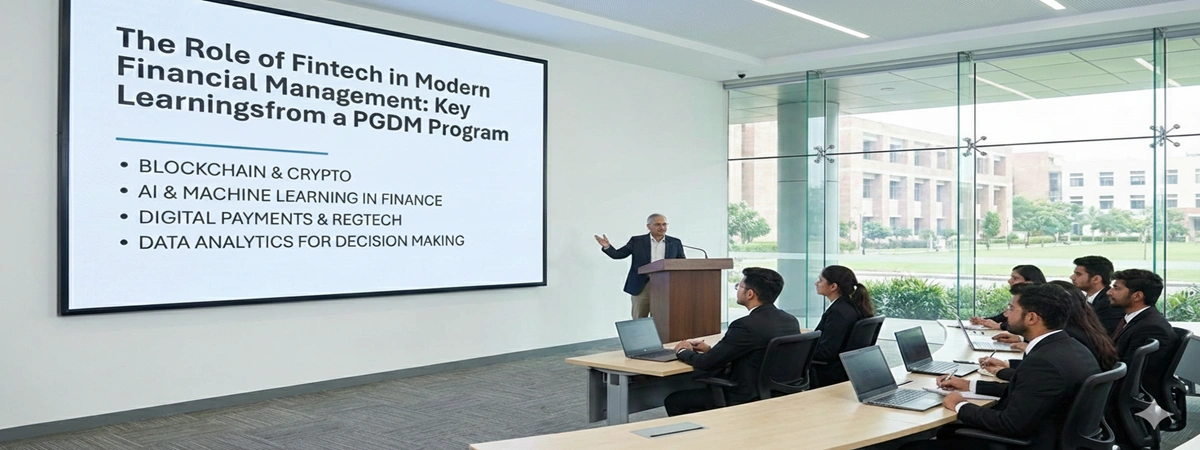
The Role of Fintech in Modern Financial Management: Key Learnings from a PGDM Program
Finance today and finance a decade ago are as similar as your social media profile picture and your picture on the aadhaar card! Ledgers have moved to the cloud, payments happen in seconds and decisions are guided by real-time data rather than gut feeling. At the heart of this transformation is Financial Technology – Fintech. It has reshaped how businesses manage money today, assess risk and also plan for growth.
For students pursuing a PGDM in Finance or Management, fintech is no longer an optional topic. It has to be learned to be relevant and competitive. Finance and technology are intertwined today. It is a must learn for anyone who wants to thrive in modern financial management systems.
This article explores the growing role of fintech and the key learnings PGDM programs offer to prepare future leaders for this dynamic landscape.
What Is Fintech and Why Does It Matter Today?
Fintech refers to the use of technology to improve, automate, and innovate financial services. It spans a wide range of applications. From digital payments—to mobile banking—to investment platforms, blockchain, artificial intelligence and data analytics, all need fintech experts.
Why does fintech matter so much today?
Because in this new era, businesses operate in an environment that demands:
- Speed – instant transactions and quick decision-making
- Accuracy – data-driven insights instead of just assumptions
- Transparency – real-time tracking of financial activities
- Customer-centricity – Personalised experiences for customers
Financial managers were expected to understand just balance sheets back then, but now, the modern financial managers are expected to understand and manage the systems and technologies that generate financial intelligence.
How Fintech Is Transforming Financial Processes
1. Smarter Decision-Making with Data
Data is playing a big role today. There are advanced analytics and AI tools to help finance professionals to interpret large volumes of data in real time. Through these tools and knowledge, finance professionals can forecast cash flows and identify cost leakages. Fintech allows managers to make informed and timely decisions.
PGDM students learn how financial data, when combined with technology, becomes a strategic asset rather than just historical information.
2. The Core Financial Processes are Automated
Tasks such as accounting entries, payroll processing, invoicing, and compliance reporting are all automated now, thanks to fintech! This reduces chances of human error and frees finance teams to focus more on strategy, planning and analysis.
A PGDM program helps students understand how automation can change the role of finance.
3. Digital Payments
Every individual and even road-side vendors have digital wallets and UPI enabled payment options today. This advances real-time settlements. Such platforms have revolutionised how businesses handle transactions. Efficient payment systems directly impact liquidity and working capital management.
Students gain exposure to how these systems work and how financial managers can optimise cash flows using digital tools.
4. Fraud Detection and Risk Management
Fintech can also help prevent and control financial frauds. As there is machine learning to detect unusual patterns, this flags risks and prevents fraud. This is needed of the hour as quick online transactions and digital assets are replacing traditional methods.
PGDM programs introduce students to technology-enabled risk management models. It helps them understand how finance and cybersecurity intersect.
5. Financial Inclusion for New Business
Financial services are accessible to startups, small businesses, and individuals today, another advancement done by fintech. This has led to innovative business models that never existed before! Such as digital lending, buy-now-pay-later and peer-to-peer financing.
Finance Management students learn how these models operate and how they influence both financial strategy and customer engagement.
Key Fintech Learnings from a PGDM Program
A well-structured PGDM program is the one that prepares students with academic concept clarity and practical exposure. Some of the most valuable fintech-related learnings are:
- Learning about fintech ecosystems and financial platforms
- Using data to analyse for financial planning and control
- Learning digital finance for regulatory frameworks
- Managing fintech-driven business cases
- Adapting the evolving financial technologies
These learnings ensure that graduates are finance-literate and also future-ready.
The Human Side of Fintech
While fintech is technology-driven, its purpose is deeply human oriented. It is to simplify decisions and reduce risks. PGDM programs emphasise this balance by teaching students how to use technology responsibly and strategically.
Financial managers are main decision-makers and leaders to play problem-solvers. Fintech is a tool that enhances their capabilities. It cannot replace experience and judgements.
Careers in a Fintech-Driven World
Graduates with fintech learnings find opportunities across job-profiles such as:
- Financial analysts and strategists
- Investment and risk managers
- Fintech consultants
- Digital banking and payment specialists
- Corporate finance professionals
- Investment Advisors
Any organisation relying on fintech solutions with well-learned professionals rules the industry.
Conclusion: Finance meets Future
Managing finances in modern world is redefined by fintech solutions. PGDM students with knowledge of fintech do not just relate with modern financial systems, but also make the best choice as perfect strategy and plan makers. By combining financial fundamentals with technological insight, management education prepares students to lead confidently in a fast-changing financial ecosystem. In this fusion of finance and technology lies the future of smart, sustainable, and strategic financial management.