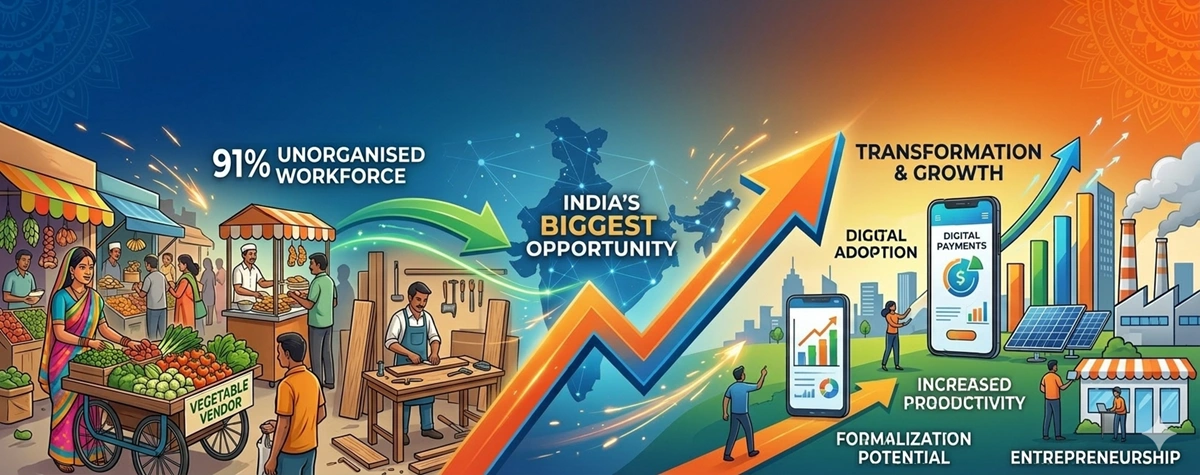
The 91% Economy: Why India’s “Unorganised” Market is Actually Its Biggest Opportunity
Every official presentation, every budget speech, every industry report frames it the same way: India’s retail market is “largely unorganised.” The FICCI data tells us that organised retail accounts for barely 9 per cent of the total sector, while the unorganised market—the kirana stores, the street vendors, the informal manufacturing units—constitutes the remaining 91 per cent.
The language is telling. “Unorganised” sounds chaotic. It sounds backward. It sounds like a problem waiting to be solved.
But what if we’ve been looking at this all wrong?
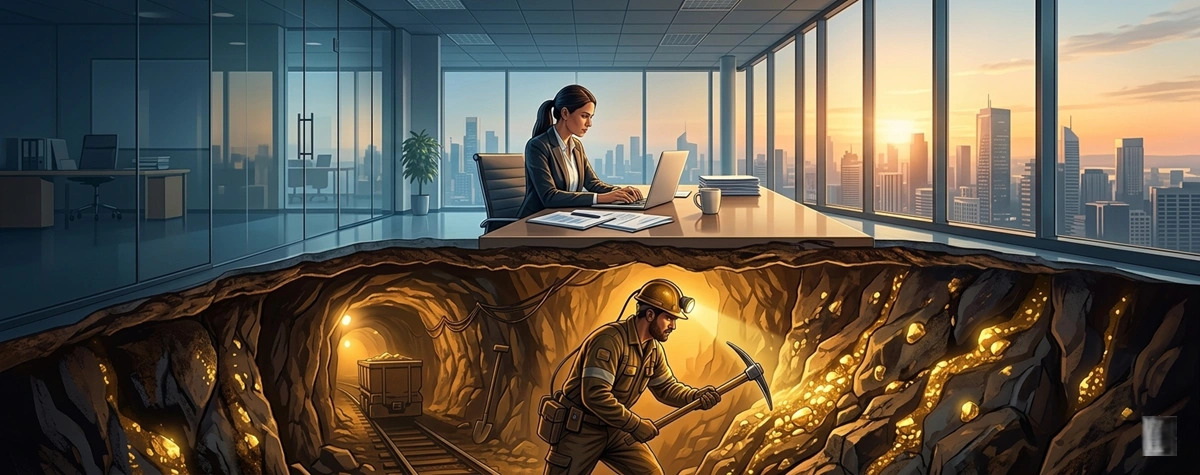
What if the 91% economy isn’t a problem to be fixed, but a parallel economic universe—one that is resilient, deeply embedded in social fabric, and quietly innovating in ways the boardrooms of Mumbai don’t understand?
Welcome to the ground reality of India’s unorganised market. It is messy, it is massive, and it is the single biggest business opportunity of the next decade.
The $1.6 Trillion Elephant in the Room
Let’s start with scale. India’s retail market sits at roughly $950 billion today and is projected to hit $1.6 trillion by 2026 -1-4. But here is the contrarian read that Pramod Arora of PVR INOX recently articulated: “This economy already exists. What we are looking forward to is perhaps organising the unorganised”.
Also Read: The Silent Goldmine of 2026: Why “Boring” is the New Brilliant in Business
Think about that. We are not creating a $1.6 trillion economy from scratch. We are simply formalising what is already there.
The unorganised sector isn’t just retail. It includes:
- Manufacturing: Two-thirds of India’s manufacturing workers—48 crore people—toil in unorganised, informal units with low productivity but high adaptability.
- MSMEs: Millions of micro-enterprises operating in a “dual-speed economy,” where digitally integrated firms thrive while informal ones struggle for survival.
- Value Retail: In non-food and grocery categories, unorganised formats still hold a staggering 79 per cent share, even as organised players scramble to catch up.
The numbers tell a story, but they don’t capture the texture. To understand the unorganised market, you need to leave the conference room and enter the lane.
The Kirana Network: 12 Million Reasons Why Amazon Should Be Worried
There are 12 million kirana stores in India. Let that number sink in. For context, the entire United States has roughly 150,000 convenience stores.
These 12 million points of consumption are not just shops—they are community institutions. The kirana owner knows the family by name. He knows when they need credit during a wedding season. He knows which household prefers which brand of atta. He offers free delivery with a smile and a conversation.
The Ground Reality: While e-commerce giants spent billions trying to replicate this intimacy through algorithms, kirana stores quietly adopted what worked for them. UPI payments now account for over 60 per cent of transactions under ₹200, meaning even the chai wallah and the vegetable vendor are digitally enabled.
As Vikas Garg, Co-founder of Paytail, notes: “With a market opportunity as big as 1.7 trillion dollars till 2026, it will not be an exaggeration to state that in approximately every single lane in India, one can find at least one such store”.
The unorganised sector didn’t resist technology. It absorbed technology on its own terms—using UPI for payments, WhatsApp for orders, and local logistics for delivery. It created a hybrid model that no corporate strategy document had predicted.
The Hidden Champions: Unlisted, Unorganised, and Unstoppable
Here is a statistic that should shake every preconception: The top 100 unlisted companies in India—the “invisible champions” operating outside the public market spotlight—are together valued at ₹28.5 lakh crore. That is larger than the GDP of Finland .
These aren’t your neighbourhood kirana stores, but they represent the formalising edge of the unorganised ecosystem. Companies like Reliance Retail (revenue: ₹2.7 lakh crore), Flipkart (₹83,000 crore), and Malabar Gold and Diamonds (₹66,000 crore) are scaling at breakneck speed—often with debt-to-equity ratios below 1 and, in cases like Zerodha and IFFCO eBazar, completely debt-free .
What this tells us: The unorganised sector isn’t a graveyard of failed businesses. It is a breeding ground for future giants. These 100 companies employ 1.2 million people and span everything from consumer goods to construction to financial services -6. They grew out of the informal economy, learned its rules, and are now poised to dominate the formal one.
The Stress Points: Where the Unorganised Economy Bleeds
But let’s not romanticise. The unorganised market is also where economic pain is felt most acutely.
- The Credit Chasm: There is a structural credit gap of around ₹30 lakh crore in the MSME sector—roughly 24 per cent of estimated demand . Micro enterprises, women-owned firms, and service-sector businesses are starved of affordable capital. Borrowing costs range between 8 to 18 per cent, and collateral requirements exclude millions.
- The Export Squeeze: US tariff hikes of up to 50 per cent on Indian goods have hit MSME-heavy sectors like textiles, engineering goods, and gems and jewellery. In some product categories, export declines of 40 to 70 per cent are being estimated. Small exporters operate on thin margins; tariffs of this magnitude don’t just reduce profits—they destroy businesses.
- The Delayed Payments Trap: An estimated ₹2–3 lakh crore in working capital is locked up in delayed payments to small suppliers -8. The 45-day payment rule exists on paper but is routinely flouted by large buyers who know that a small vendor cannot afford to walk away from a contract.
- The Labour Unrest: On 12 February 2026, over 300 million workers—from coal mines to public offices, from formal factories to informal sectors—went on strike, bringing vast sections of the country to a standstill . This wasn’t about one issue. It was about four labour codes pushed through without consultation, about weakening collective bargaining, about nearly 70 per cent of factories being pushed outside labour law coverage.
The unorganised economy is not just an economic space. It is a political space. And when 300 million people feel unheard, they mobilise.
The Opportunity: Organising Without Destroying
So where does the business opportunity lie? Not in bulldozing the unorganised sector and building malls on its ashes. That approach has failed for three decades. The organised retail share has remained stuck at single digits for years.
The real opportunity lies in what I call “organisation without formalisation”—bringing the benefits of technology, supply chain efficiency, and access to capital without destroying the human fabric that makes the unorganised sector resilient.
1. The B2B Kirana Tech Stack
The next wave of Indian entrepreneurship won’t be B2C e-commerce competing with kirana stores. It will be B2B platforms powering those kirana stores.
- Inventory management SaaS that helps the local shopkeeper track stock, predict demand, and automate reordering.
- Working capital platforms that use transaction data to offer small-ticket, unsecured loans at reasonable rates.
- Supply chain aggregation that allows 1,000 small retailers to buy together, accessing wholesale prices previously reserved for large chains.
The Wadhwani Foundation rightly identifies that “the biggest opportunity lies in applying simple, scalable technology to complex, traditional sectors” -9. The kirana store is the most complex, traditional sector of them all—and it is ripe for a tech-enabled layer that sits underneath, not on top.
2. The Scrap and Circular Economy Goldmine
Here is a sector that is almost entirely unorganised but represents a $30-40 billion opportunity: waste and recycling.
India’s demand for recycling and raw material recovery is exploding. The metal recycling market is growing at 12–14 per cent annually. E-waste recycling is expanding at 14–16 per cent per year .
The Ground Reality: This is currently a fragmented, unorganised space—scrap dealers, kabadiwalas, small dismantling units. But it is rapidly becoming a tech-driven, efficient industry.
- Plastic recycling: With government pushing Extended Producer Responsibility (EPR) rules, FMCG companies are desperate for reliable sources of recycled granules. A plastic recycling unit requiring ₹10–35 lakh investment can yield monthly profits of ₹1–4 lakh.
- E-waste recycling: Starting at ₹20–70 lakh, monthly profits can hit ₹2–8 lakh from extracting precious metals and selling refurbished electronics .
- Vehicle scrappage: With India’s vehicle scrappage policy accelerating, organised scrapyards are set to explode. Investments between ₹35 lakh and ₹1.2 crore can yield monthly earnings of ₹3–12 lakh .
This is the unorganised sector formalising from within—not because a corporation is taking over, but because entrepreneurs are seeing the opportunity and building businesses that respect the existing ecosystem while adding efficiency.
3. The Skilling and Compliance Layer
The single biggest hurdle cited by industry leaders in retail and manufacturing is talent . Not a lack of people—a lack of skilled, trained, job-ready people.
The unorganised sector employs crores of workers, but most have never received formal training. They learn on the job, from a father or an uncle, in a unit that has never heard of ISO standards or safety protocols.
The Opportunity: Building skilling platforms that specifically target the unorganised workforce.
- A mobile app that teaches a factory worker in an unorganised unit how to operate a CNC machine safely.
- A certification programme for kirana store owners on inventory management and customer service.
- A compliance assistant that helps small manufacturers navigate GST, labour codes, and environmental regulations without hiring a chartered accountant.
As Vinod Kumar of the India SME Forum warns, “firms that treat compliance as an annual exercise will struggle” -8. But for micro-enterprises, compliance is genuinely complex. A tech-enabled layer that simplifies it could be worth billions.
4. The Value Retail Revolution
Here is a counter-intuitive trend: while premium retail struggles with slowing growth, value retail is exploding. The non-food and grocery value retail market is projected to reach $170 billion by 2026, growing at a CAGR of 15 per cent.
Who is driving this? Tier 2 and 3 cities. Consumers in smaller towns are increasingly aspirational, brand-aware, and willing to try new products—but they remain price-sensitive -7. They want the experience of organised retail at prices that unorganised retail offers.
This has attracted heavyweights: ABFRL launched Style Up, Tata Trent launched Zudio, Reliance launched Yousta -7. But the real action is still in the unorganised space—the local clothing store that knows exactly what the neighbourhood wants, the shoe shop that stocks the right sizes for local feet.
The winning model won’t be a shiny mall in a Tier 2 city. It will be a hybrid—organised supply chains feeding unorganised retail outlets, giving them the product range to compete with malls while retaining their local connect.
Conclusion: The 91% Is Not a Problem—It’s the Solution
For too long, Indian business discourse has been dominated by a formal-sector bias. We celebrate the IPOs, the unicorns, the billion-dollar exits. We forget that the real Indian economy runs on 12 million kirana stores, 63 million MSMEs, and 300 million workers who show up every day without a formal contract.
The unorganised sector is not a relic of the past. It is the architecture of the present and the foundation of the future. It is resilient—it survived demonetisation, GST, a pandemic, and now geopolitical trade shocks. It is adaptive—it adopted UPI faster than many organised players. It is massive—it accounts for 91 per cent of retail and two-thirds of manufacturing employment.
The businesses that win in the next decade will be those that understand one simple truth: You don’t defeat the unorganised sector. You join it.
You build tools that make the kirana store more efficient without replacing it. You create platforms that help the small manufacturer access credit and markets. You design skilling programmes that uplift the informal worker without demanding they abandon their community.
The 91% economy is not a problem waiting to be solved. It is an opportunity waiting to be embraced.
And in 2026, with global headwinds and domestic pressures mounting, embracing the unorganised sector isn’t just good business. It’s the only business that makes sense.