The Silent Goldmine of 2026: Why “Boring” is the New Brilliant in Business
Every business blog this January is screaming the same thing. AI. AI. AI. And look, I get it. We are in the midst of a technological tidal wave. As Tom Oliver recently noted, the AI revolution is “more transformative on a global scale than even the advent of the internet,” and we are still “incredibly early in the game” 1.
But here is the paradox of the hype cycle: When everyone is looking at the same shiny object, the real money moves to the shadows.
If you want to build a business that not only survives 2026 but dominates it, you need to stop staring at the screen and start looking at the stuff around you. The most interesting business topic right now isn’t a new chatbot or a better GPU. It’s the radical reshaping of the physical world—the factories, the soil, the apartment buildings, and the tired hands of the aging workforce.
Here are four business opportunities that are flying completely under the radar.
1. The “Modern Metal Mill” and the Software-Defined Factory
When you think of “tech,” you think of sleek offices and venture capital in San Francisco. You don’t think of a steel foundry. But according to Y Combinator’s latest “Startup Wish List,” that is exactly where the future lies.
We have spent two decades optimizing code. We haven’t spent nearly enough time optimizing things.
Right now, if you want to buy a specific aluminum tube in the U.S., you might wait 8 to 30 weeks for delivery . This isn’t because workers are lazy; it’s because the production management systems were designed in the 1980s. These factories optimize for “tonnage” and “utilization rate” while sacrificing speed and flexibility.
Also Read: How Does Dual Specialization Benefit PGDM Students?
The Opportunity: Bringing AI-driven production planning and real-time manufacturing execution systems (MES) to “old school” industries like metal mills, construction, and mining.
Why is no one talking about this? Because it’s hard. It requires getting your hands dirty. But autonomous robotics are already being tested in logistics and mining, and connecting them to intelligent software is the next logical step . If you can build a “software-defined” factory that compresses an 8-week lead time into 2 weeks, you don’t need to worry about venture capital trends—your customers will line up with cash in hand.
2. Regenerative Textiles: Proof, Not Promises
“Sustainability” is a dirty word in 2026. It’s been overused, greenwashed, and ignored. But while everyone is tired of hearing about “eco-friendly” products, a massive shift is happening in the background: Regenerative Textiles.
Consumers are no longer buying “recycled polyester.” They want proof of soil health impact. They want verifiable biodiversity credits woven into the fabric. Searches for “regenerative cotton bedding” grew 143% year-over-year in 2025.
The Opportunity: Selling products that come with a QR code linking directly to a soil carbon sequestration report.
This isn’t about feeling good; it’s about traceability. New infrastructure—like blockchain-enabled fiber tracking and the Soil Health Institute’s Regenerative Organic Certified® standard—now allows brands to offer margins as high as 62% on wool blankets or 58% on sheets . This niche sits at the intersection of climate tech and luxury goods, and right now, it’s a ghost town compared to the crowded AI space.
3. The “Super Blue-Collar” AI Guide
Everyone is panicking about AI taking white-collar jobs. But very few people are talking about how AI will save blue-collar work .
We are facing a massive shortage of skilled labor. We don’t have enough people to fix furnaces, repair EVs, or install charging stations. Meanwhile, the workforce that does exist is aging.
The Opportunity: Real-time AI guidance for physical work. Imagine a junior repair technician walking onto a job site wearing smart glasses. The AI sees the broken valve, recognizes the model, and whispers in their ear: *”Turn off the red valve. Use a 3/8 inch wrench. That part is worn out; replace it.”*. This isn’t science fiction. The maturation of multimodal models makes this possible today. While the tech world is building “Copilots” for writing code, the smart money will build “Copilots” for fixing boilers. It’s a massive, untapped market hiding in plain sight.
4. The Human Connection Premium
Here is the most contrarian thought of all: As the world goes all-in on AI, the ultimate business advantage will be human connection.
Harvard Business School professor Debora Spar predicts that as smart machines become ubiquitous, we will increasingly crave things they cannot produce: “connection and community.” She argues that “service is important. One day soon, it may be a primary differentiator, the reason we do business with one company over another”.
The Opportunity: Coaching and hyperlocal services.
When a worker is displaced by AI (and 67% more entrepreneurs launched ventures after layoffs in 2024), they don’t need a chatbot, they need a coach . They need someone to help them navigate the emotional turmoil of a career shift. They need accountability.
Similarly, while e-commerce giants fumble with tariffs and returns, hyperlocal retail is making a comeback—physical spaces curated by creators, acting as community hubs . AI can write a poem, but it can’t fix a sink, build a deck, or look a customer in the eye and build trust.
Conclusion: Ride the Wave, Don’t Get Buried
The biggest mistake in business is ignoring trends. The second biggest? Following them so blindly that you miss the adjacent possibilities.
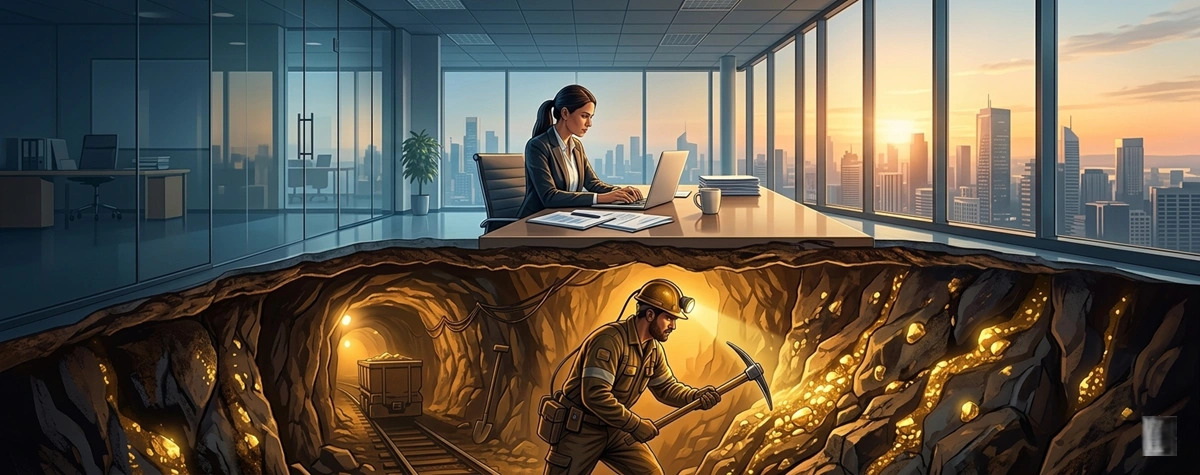
The AI revolution is laying down the infrastructure, but the gold rush is happening in the industries that AI touches—the factories it automates, the soil it helps regenerate, the hands it guides, and the lonely humans it leaves behind needing connection.
In 2026, stop looking at the screen. Look out the window. That “boring” industry you’ve been ignoring? It might be your next million-dollar idea. Programs like PGDM with Dual Specialization are helping future business leaders understand emerging trends, combine multiple skill sets, and identify these hidden opportunities in evolving industries.